Beginner Jazz Passing Chords And Reharmonization
Course outline · Read online
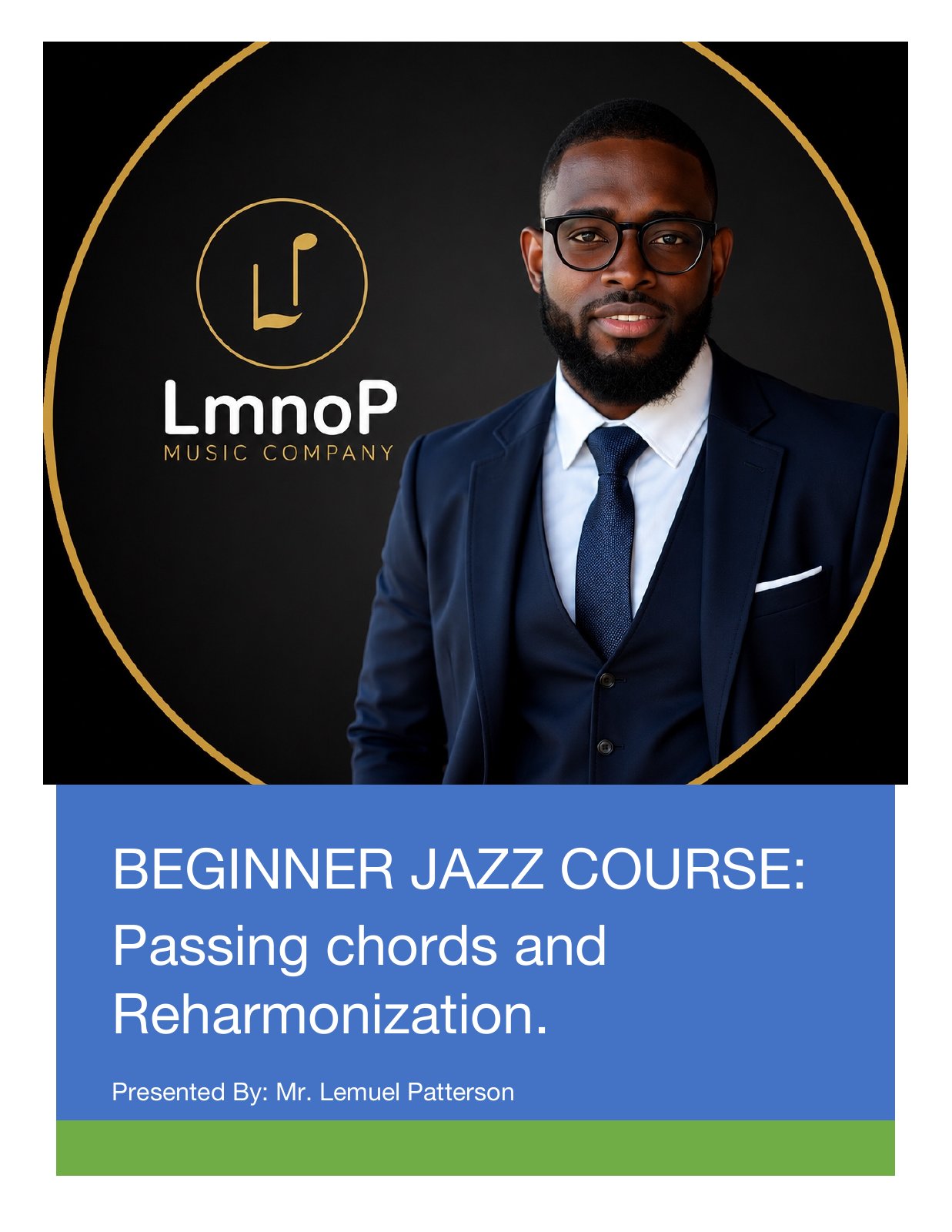
BEGINNER JAZZ COURSE:
Passing chords and
Reharmonization.
Presented By: Mr. Lemuel Patterson
Page 1 of 7
‘INSPIRING YOU TO INSPIRE OTHERS’
TEL: +1(868)277-4874/ +1(868)335-5578
EMAIL: lmnopmusiccompany@gmail.com
BIOGRAPHY:
From a young age, Lemuel was always attracted to music and as he grew, his passion did also.
From sitting in a stroller, watching gospel artiste such as Alvin Slaughter and Ron Kenoly, to
being the competent musician he is today, it is evident that Lemuel is deeply submerged into the
Art they call Music.
In his lifetime, Lemuel has been teaching Music for over 10 years. Currently he works as a Music
Instructor with the Primary School Music Programme Unit. He is currently the holder of two
Bachelor Degrees, one in Management Studies and the other in Performing Arts with
Specialization in Music. Lemuel also holds certificates up to grade 6 Practical and up to grade 7
theory from Trinity Guildhall in London. Not only does he have the papers to prove it, but had the
pleasure to play alongside some of the greatest musicians in Trinidad and Tobago. Names such as
Tony Paul, Jason Bishop, Rodney Alexander, Jill Ann Walters-Morris, just to name a few. In
addition, he had the privilege of playing with the All Star Cast at Jazz on the Greens (2018) and
accompanied Quinton Neckles at Shangri-La in Tobago (2019). The highlight of his music career
was playing bass guitar for Cuban Jazz Pianist, Janysett McPherson at Kaiso Blues, Port of Spain
(2018). He calls it an unforgettable experience; one that will be forever etched in his memory.
Lemuel Patterson loves the idea of inspiring people through his music. His theory is this: “You
must never leave a music concert the same way you came; something in the music must change
you.” This concept never left his thoughts. Whether teaching, composing, arranging, performing
or music directing, the goal for him will always be “To inspire.”
At present, Lemuel is currently the owner of ‘LmnoP Music Company’ where the motto is
“INSPIRING YOU TO INSPIRE OTHERS.” All of this, is a result of his passion for music,
helping upcoming musicians acquire the skills needed to inspire others.
Page 2 of 7
‘INSPIRING YOU TO INSPIRE OTHERS’
TEL: +1(868)277-4874/ +1(868)335-5578
EMAIL: lmnopmusiccompany@gmail.com
Beginner J azz Cour se: Passing Chor ds & Rehar monization
This 15-class course is designed to introduce students to passing chords and reharmonization in
jazz. The course starts with basic concepts and gradually moves into more advanced techniques.
Each session will be 60 minutes long and will include a mix of theor y, pr actical application,
and ear tr aining.
Section 1: Passing Chor ds (10 Classes)
Class 1: Intr oduction to Passing Chor ds
• Definition and purpose of passing chords.
• Basic concept: Connecting primary chords using smooth transitions.
• Common passing chords: Dominant chords, diminished chords, Major chords, minor chords.
• Simple example: C → G7 → C
Homewor k:
1. Practice inserting G7 as a passing chord between C and C major (C → G7 → C). Using Alice in
wonderland as a practice piece.
2. Listen to a jazz recording and try to identify passing chords by ear.
Class 2: Diatonic Passing Chor ds
• Understanding diatonic passing chords in major keys
• Using the ii-V-I progression as a passing chord device
• Example: C → Dm7 → G7 → C
Homewor k:
1. Play and internalize ii-V-I progressions in any scale.
2. Analyze ii-V-I progressions in a jazz song of your choice.
Class 3: Chr omatic Passing Chor ds
• Definition of chromatic passing chords
• Half-step approaches to target chords
• Example: C → C#dim → Dm7 → G7 → C
Homewor k:
1. Insert chromatic passing chords between major chords in C major.
2. Practice playing C → C#dim → Dm7 → G7 → C smoothly.
Page 3 of 7
‘INSPIRING YOU TO INSPIRE OTHERS’
TEL: +1(868)277-4874/ +1(868)335-5578
EMAIL: lmnopmusiccompany@gmail.com
Class 4: Secondar y Dominant Passing Chor ds
• Introduction to secondary dominants (V7 of V)
• How to use them to create tension and resolution
• Example: C → A7 → Dm7 → G7 → C
Homewor k:
1. Play secondary dominants (V7 of V, V7 of ii) in the key of C.
2. Try incorporating A7 before Dm7 in jazz tunes you know.
Class 5: Diminished Passing Chor ds
• The function of diminished passing chords
• Common movements using diminished chords
• Example: C → C#dim → Dm7 → G7 → C
Homewor k:
1. Practice diminished passing chords in C major.
2. Experiment with inserting diminished passing chords in a simple jazz tune.
Class 6: Tr itone Substitutions as Passing Chor ds
• The concept of tritone substitution
• Substituting dominant chords for smoother transitions
• Example: C → Db7 → C
Homewor k:
1. Replace G7 with Db7 in ii-V-I progressions. Using Autumn Leaves.
2. Identify tritone substitutions in jazz recordings.
Class 7: Dominant Chor d Extensions & Alter ations
• Using extensions (9ths, 11ths, 13ths) for color
• Adding altered tones (#5, b9, #9) to passing chords
• Example: C → Dm7 → G7(#5) → C
Homewor k:
1. Play ii-V-I progressions with altered dominants.
2. Try adding an altered G7 chord in a jazz standard.
Page 4 of 7
‘INSPIRING YOU TO INSPIRE OTHERS’
TEL: +1(868)277-4874/ +1(868)335-5578
EMAIL: lmnopmusiccompany@gmail.com
Class 8: Appr oach Chor ds & Enclosur es
• How to use approach chords (chromatic and diatonic)
• Enclosing the target chord with surrounding chords
• Example: C → Bb7 → Bdim → C
Homewor k:
1. Play approach chords leading to major and minor chords.
2. Experiment with enclosing target chords in a jazz tune.
Class 9: Walking Bass & Passing Chor ds Integr ation
• How passing chords interact with walking bass lines
• Example: Using diatonic and chromatic passing chords with bass movement
Homewor k:
1. Play a simple ii-V-I progression with walking bass and passing chords.
2. Try walking bass lines with chromatic passing chords.
Class 10: Combining All Techniques
• Recap of all passing chord techniques
• Applying multiple passing chords in a single phrase
• Example: C → A7 → Dm7 → G7(#5) → C
Homewor k:
1. Take a jazz tune and apply multiple passing chords.
2. Record yourself playing a jazz progression with passing chords.
Section 2: Rehar monizing the Melody (5 Classes)
Class 11: Intr oduction to Rehar monization
• Definition and purpose of reharmonization
• Simple ways to replace chords while keeping the melody intact
• Example: Replacing I → IV → V with iii → vi → ii → V
Homewor k:
1. Pick a simple melody and try reharmonizing with diatonic chords.
2. Listen to a jazz standard and identify reharmonization.
Page 5 of 7
‘INSPIRING YOU TO INSPIRE OTHERS’
TEL: +1(868)277-4874/ +1(868)335-5578
EMAIL: lmnopmusiccompany@gmail.com
Class 12: Using Secondar y Dominants & Tr itone Subs for Rehar monization
• Applying secondary dominants to existing chord progressions
• Swapping dominant chords with tritone substitutions
Homewor k:
1. Reharmonize a ii-V-I progression using secondary dominants.
2. Replace V7 chords with their tritone substitutes in a song.
Class 13: Modal Inter change & Bor r owed Chor ds
• Using borrowed chords from parallel modes
• Example: Borrowing iv from the minor key in a major progression
Homewor k:
1. Experiment with modal interchange in a song.
2. Play ii-V-I progressions using borrowed chords.
Class 14: Diminished & Augmented Chor ds in Rehar monization
• How to use diminished and augmented chords for tension
• Example: Replacing ii-V-I with iiº7 → V7 → I
Homewor k:
1. Replace dominant chords with diminished passing chords in a tune.
2. Try using augmented chords in a jazz progression.
Class 15: Full Song Rehar monization Pr oject
• Reharmonizing an entire jazz standard
• Applying multiple techniques learned in the course
Homewor k:
1. Choose a jazz standard and fully reharmonize it.
2. Record yourself playing the reharmonized version.
Page 6 of 7
‘INSPIRING YOU TO INSPIRE OTHERS’
TEL: +1(868)277-4874/ +1(868)335-5578
EMAIL: lmnopmusiccompany@gmail.com
Materials needed for the course:
-
A notebook for taking notes.
Pen and pencil
Keyboard
All other material will be given online via a google classroom. PDF’s, presentations, and
Audio files will be included.
Payment:
The cost of this course per class is two hundred dollars ($210.00) I take payments each class to
safeguard both clientele and myself. You will receive an invoice each via email and payments
must be made dfor class time. If you are unable to do so, you can talk to the teacher, letting him
know when payment would be made. Failure to do so, will result in the cancellation of lessons.
Payments can be made via cash or bank transfers. Here is my banking information.
Name on Account: Lemuel Patterson
Bank: FCB
A/c #: 2613561
When payment is made, please send a screenshot which provides proof of payment. Upon
receiving payment, your receipt will be sent via email.
Feel free to ask any questions regarding the course. You can reach me at 277-4874.
THE END.
Page 7 of 7